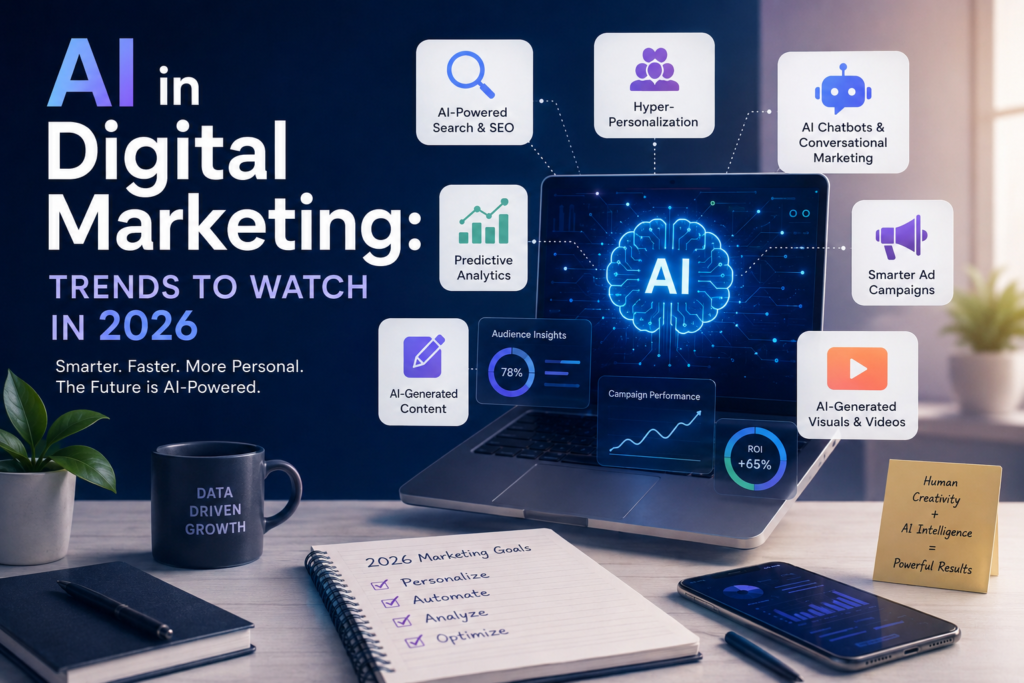
Artificial intelligence (AI) has transformed digital marketing from a largely manual process into a faster, more data-driven, and increasingly personalized field. From generating content and analyzing customer behavior to optimizing advertising campaigns, AI is becoming an important part of how businesses connect with their audiences.
In 2026, AI is moving beyond simple automation. Marketers are increasingly using AI to understand audiences, create personalized experiences, predict trends, improve search visibility, and make better marketing decisions. For businesses and digital marketers, understanding these changes is essential to staying competitive.
Here are the major AI in digital marketing trends to watch in 2026.
1. AI-Powered Search Is Changing SEO
Search behavior is changing rapidly. People are no longer relying only on traditional search engines to find information. AI-powered search experiences can provide direct answers, summaries, recommendations, and comparisons.
This means marketers need to think beyond traditional keyword rankings. Content should be useful, accurate, well-structured, and capable of answering specific user questions.
In 2026, Answer Engine Optimization (AEO) and Generative Engine Optimization (GEO) are becoming increasingly important alongside traditional SEO.
Instead of creating content simply to rank for a keyword, marketers should focus on answering search intent clearly and providing information that AI-powered search systems can understand and reference.
2. AI-Generated Content Will Become More Strategic
AI writing tools can help marketers generate blog ideas, social media captions, email drafts, product descriptions, and other marketing content in a short amount of time.
However, simply publishing AI-generated content is not enough.
In 2026, successful marketers will use AI as a content assistant rather than a complete replacement for human creativity. AI can help with research, brainstorming, outlines, and first drafts, while humans provide personal experience, originality, storytelling, fact-checking, and brand voice.
The strongest strategy is likely to be a combination of AI efficiency and human expertise.
3. Hyper-Personalization at Scale
Customers increasingly expect brands to understand their interests and provide relevant experiences.
AI allows marketers to analyze large amounts of customer data and identify patterns in behavior. Businesses can use these insights to personalize website experiences, product recommendations, email campaigns, advertisements, and social media content.
For example, an online fashion store could use AI to recommend products based on a customer’s previous interactions and browsing behavior.
In 2026, personalization will increasingly move from basic segmentation toward individualized customer experiences.
4. AI-Powered Social Media Marketing
Social media marketers are using AI throughout the content creation process.
AI tools can help identify content ideas, analyze audience engagement, generate captions, suggest posting times, and evaluate campaign performance.
AI can also help marketers identify emerging conversations and trends. This allows brands to respond more quickly to changes in audience interests.
However, social media still depends heavily on authenticity. Audiences can recognize repetitive or overly automated content. Therefore, marketers should use AI to improve efficiency while keeping the brand’s personality and human perspective.
5. Predictive Analytics Will Improve Marketing Decisions
One of the most valuable applications of AI is its ability to analyze historical and real-time data to identify patterns.
Predictive analytics can help marketers estimate which customers are more likely to purchase, which campaigns may perform well, and which audiences are likely to respond to particular offers.
Instead of waiting until a campaign ends to analyze results, marketers can use AI-powered insights to make adjustments during the campaign.
This can help businesses use their marketing budgets more effectively and make decisions based on data rather than assumptions.
6. AI in Paid Advertising
Digital advertising platforms are increasingly using AI to automate parts of campaign management.
AI can assist with audience targeting, bidding, creative variations, budget allocation, and performance optimization.
For marketers, this means their role is shifting. Instead of manually controlling every campaign setting, marketers need to focus more on strategy, creative direction, audience understanding, and interpreting performance data.
Strong creative assets and clear campaign objectives will remain important even as advertising becomes more automated.
7. AI Chatbots and Conversational Marketing
AI-powered chatbots are becoming more capable of handling customer conversations.
Businesses can use conversational AI to answer frequently asked questions, provide product information, assist customers, and guide visitors through the buying process.
In 2026, conversational marketing is likely to become more personalized. Instead of providing the same response to everyone, AI systems can use available context to provide more relevant answers.
However, businesses should maintain clear boundaries around automated customer service and provide access to human support when a situation requires it.
8. AI-Generated Visual and Video Content
Visual content is essential for platforms such as Instagram, YouTube, Pinterest, and TikTok. Creating high-quality images and videos traditionally requires significant time and resources.
AI-powered creative tools can now assist with image generation, video creation, editing, animation, and variations of advertising creatives.
For small businesses and individual creators, this can make professional-looking content more accessible.
At the same time, marketers need to consider originality, copyright, transparency, and brand consistency when using AI-generated media.
9. AI Agents and Marketing Automation
Another important development is the growth of AI agents. Unlike simple tools that perform one task, AI agents can potentially handle multiple connected tasks based on a marketing objective.
For example, an AI-powered workflow could help research a topic, organize information, create a content draft, prepare social media variations, and analyze campaign data.
This could significantly reduce repetitive work for marketing teams.
However, human oversight remains important. Marketers need to review outputs, verify information, and make strategic decisions before content or campaigns go live.
10. Trust, Privacy, and Responsible AI
As AI becomes more powerful, responsible use will become increasingly important.
Businesses need to consider customer privacy, data security, transparency, bias, copyright, and misinformation when implementing AI systems.
Consumers also want to know how their data is being used. Brands that use AI responsibly and communicate clearly with customers can build stronger long-term trust.
Therefore, the future of AI marketing is not simply about using the most advanced technology. It is about using technology responsibly while protecting customer interests.
The Future of AI in Digital Marketing
AI is changing digital marketing, but it does not eliminate the need for marketers. Instead, it is changing what marketers spend their time doing.
Routine tasks can increasingly be automated, allowing marketers to focus on strategy, creativity, storytelling, research, and building relationships with audiences.
The most successful digital marketers in 2026 will likely be those who understand both technology and people. Knowing how to use AI tools is valuable, but understanding customers, creating meaningful content, and developing strong marketing strategies remains equally important.
Conclusion
AI in digital marketing is no longer just a future concept—it is becoming part of everyday marketing.
From AI-powered search and personalization to predictive analytics, advertising automation, chatbots, and creative tools, AI is creating new opportunities for businesses of all sizes.
However, the goal should not be to automate everything. The real advantage comes from combining AI’s speed and analytical capabilities with human creativity, judgment, and authenticity.
As we move through 2026, marketers who learn how to work effectively with AI while maintaining a strong human perspective will be better prepared for the rapidly evolving digital landscape.